




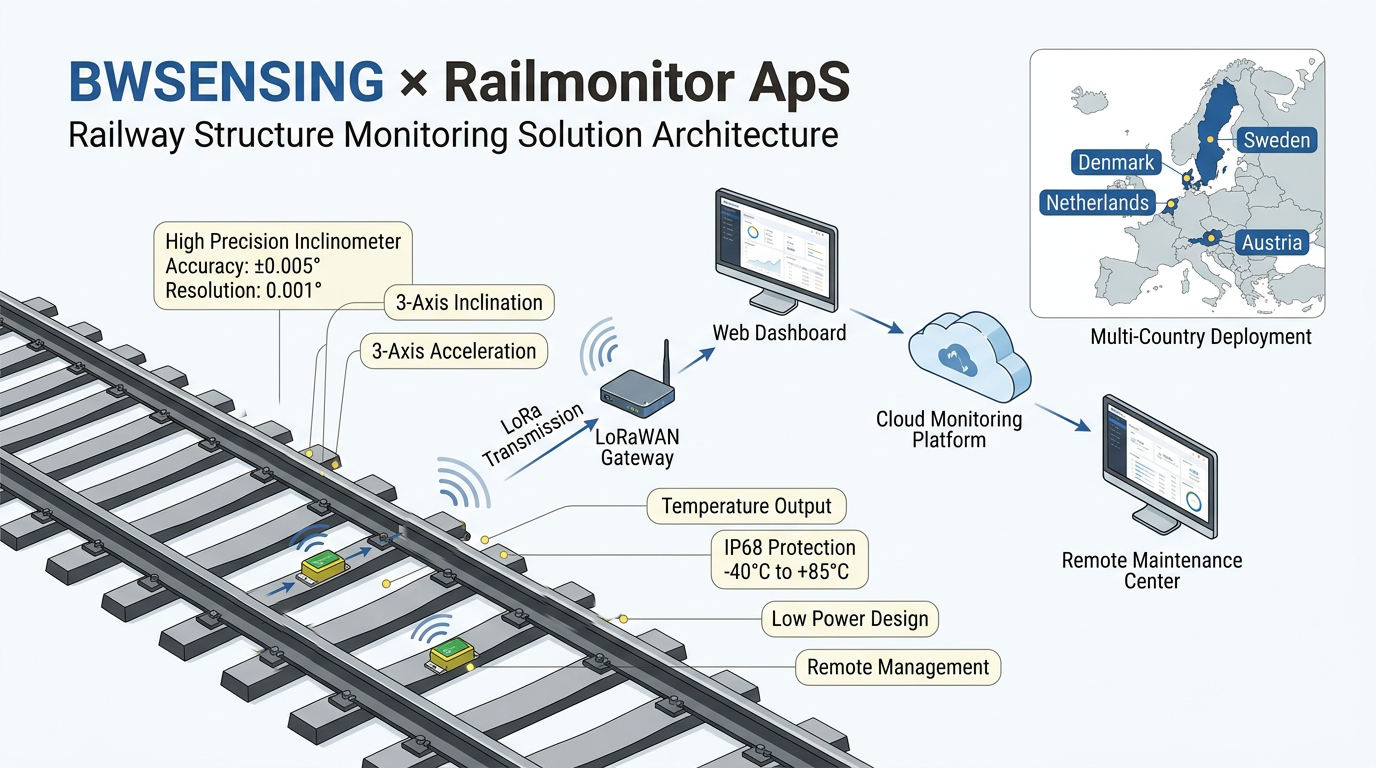
BWSENSING has partnered with Railmonitor ApS, a Danish company specializing in railway structure safety monitoring, for more than six years.
Shared:


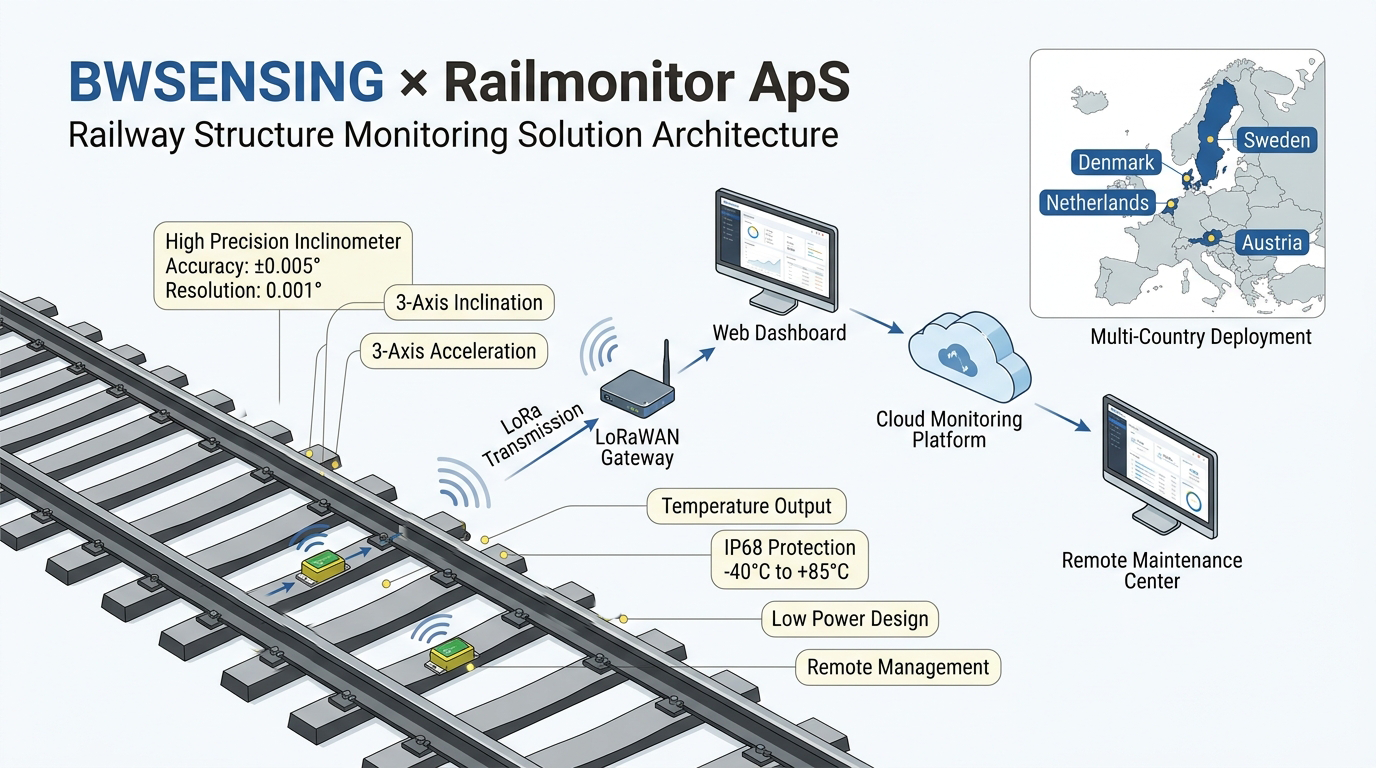
BWSENSING has maintained a close partnership of over six years with Railmonitor ApS, a Denmark-based company specializing in railway structure safety monitoring. During this long-term cooperation, BWSENSING has provided high-precision wireless inclinometer solutions for rail structure monitoring projects across Denmark, the Netherlands, Sweden, Austria and other European markets.
From early engineering prototypes, to the field validation of the standard LWHD-WM400, and later to the co-development of the RM-1 model in 2024 for measuring rail vertical Z-axis displacement during train passage, this collaboration demonstrates BWSENSING’s strong technical capability in inertial attitude sensing, as well as its customer-oriented approach to product optimization and innovation.
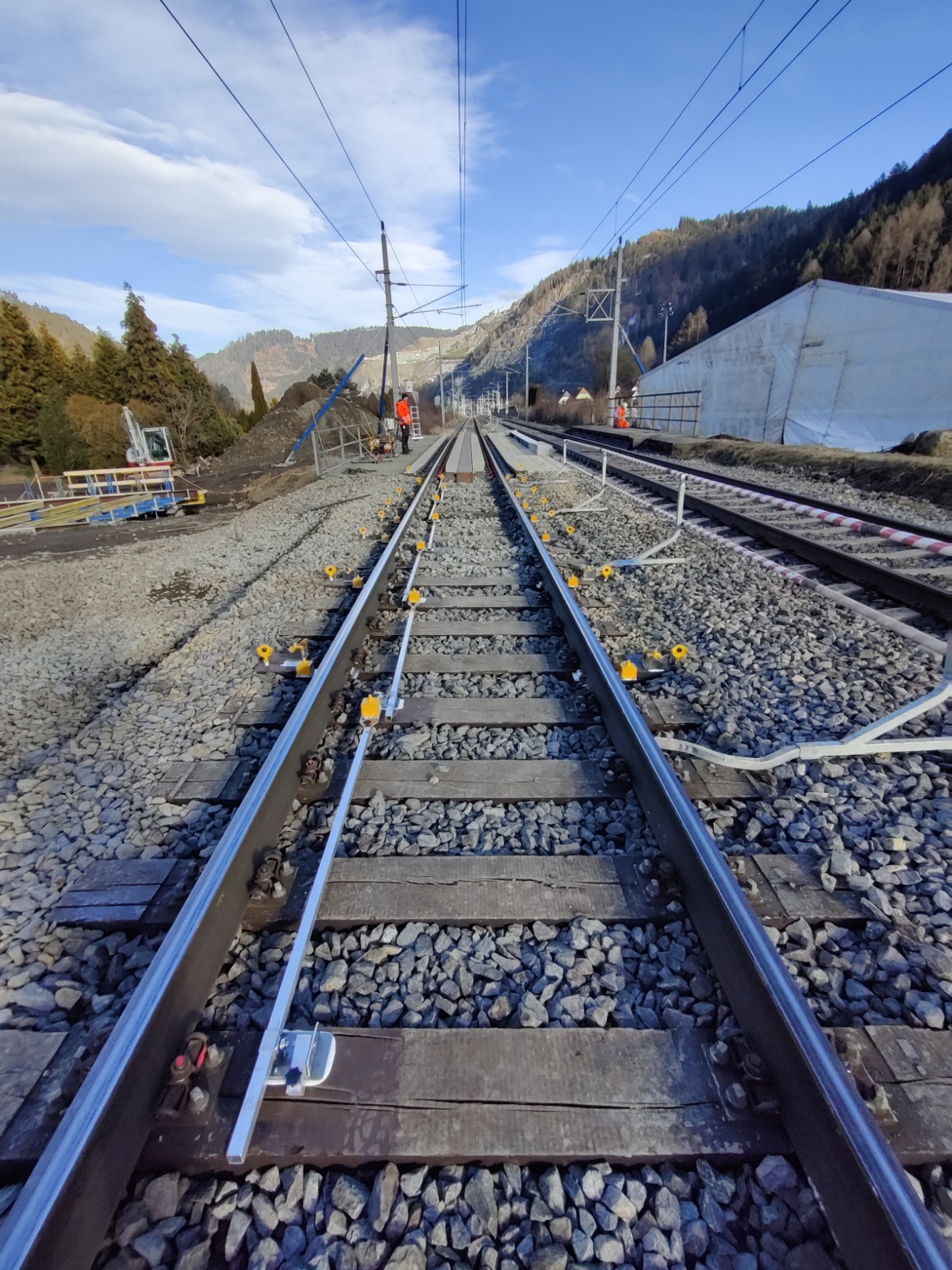
 Figure 1. Field deployment of the rail monitoring solution, with distributed sensing points arranged along the track to capture structural response over a wider monitored section.
Project Background
Railway infrastructure is continuously exposed to repeated train loading, long-term vibration, settlement, thermal expansion and changing environmental conditions. In many cases, structural problems do not begin with dramatic displacement, but with very small attitude changes that accumulate over time. For rail monitoring specialists, the challenge is therefore not only to collect data, but to detect subtle structural variation accurately and consistently under real field conditions.
Railmonitor ApS required a sensing solution that could support both pilot testing and scalable international deployment. The system needed to be precise enough to capture small angular changes, robust enough for long-term outdoor railway environments, and efficient enough to reduce installation complexity across distributed monitoring sites. In this context, measurement precision became one of the most critical requirements, because only high-quality sensing data can provide meaningful support for structural assessment and maintenance decision-making.
Industry Challenges
In rail structure monitoring, one of the main industry pain points is the difficulty of identifying very small structural changes at an early stage. Minor inclination variation, settlement or track response may easily be masked if the sensor resolution is insufficient or if the output stability is not strong enough. For customers, this means that sensing precision directly affects the value of the monitoring system.
Another challenge lies in the field environment itself. Railway assets are exposed to rain, temperature fluctuation, vibration, dust and long-term outdoor operation. Sensors must therefore maintain stable performance in harsh conditions rather than only under laboratory testing scenarios.
At the same time, traditional wired deployment often increases installation complexity and maintenance cost, especially for projects that need to be expanded across multiple sites or countries. For a specialized monitoring company like Railmonitor ApS, it was important to adopt a solution that could balance precision, practicality and scalability.
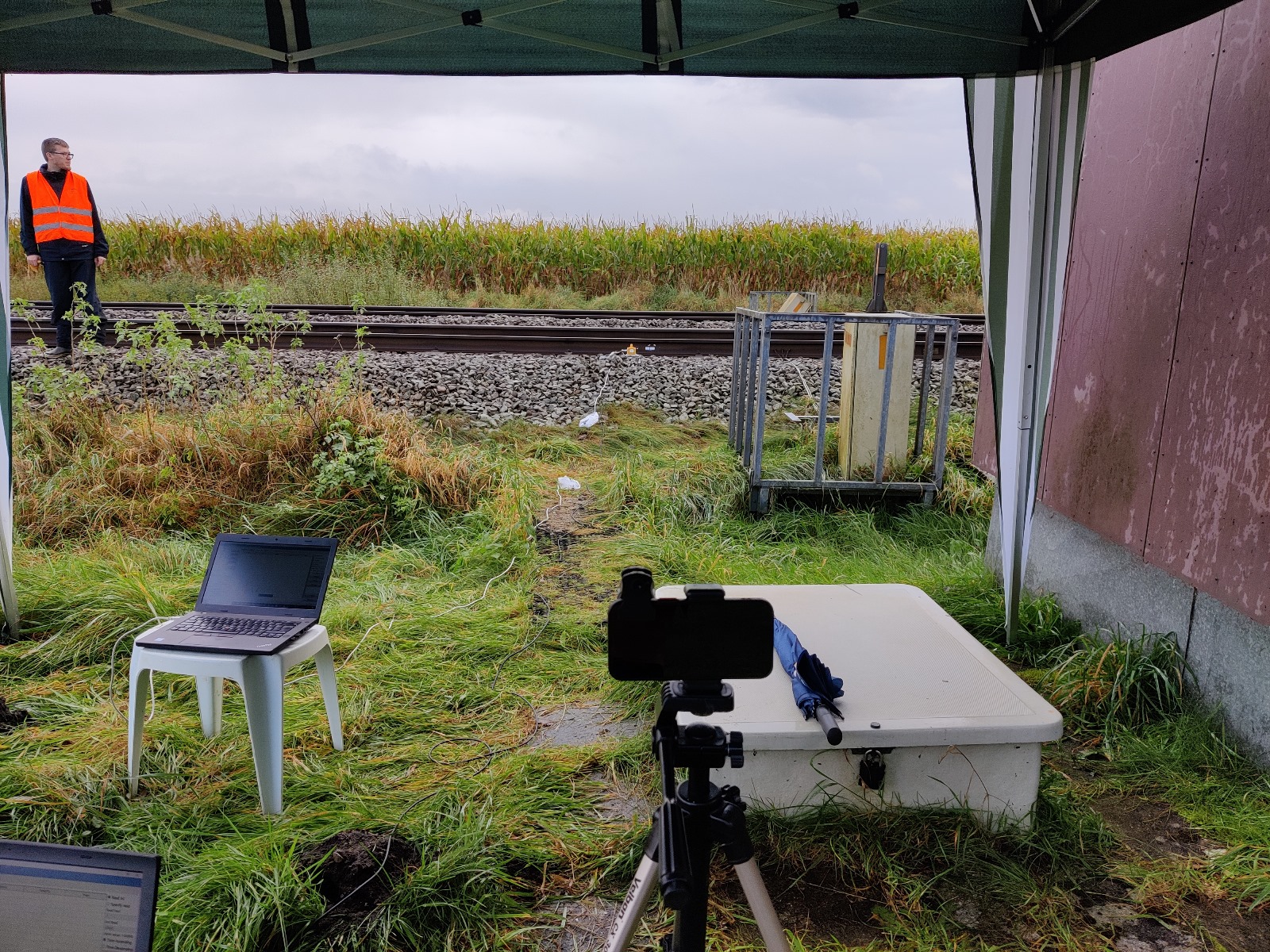
 Figure 2. On-site validation and data acquisition setup during field testing.
The BWSENSING Solution
To address these challenges, BWSENSING provided its LWHD-WM400 wireless inclinometer as a core sensing solution for rail structure monitoring, featuring low-power LoRa transmission based on the LoRaWAN communication protocol.
The product combines high-precision angle measurement with low-power LoRa transmission, making it highly suitable for projects that require both reliable sensing quality and flexible field deployment. Over the years, the LWHD-WM400 has been continuously validated and optimized through actual railway monitoring applications, helping Railmonitor ApS improve monitoring efficiency and data reliability for its end users.
More importantly, this cooperation was not limited to product supply. Based on long-term field feedback and real application requirements, both sides continuously refined the sensing solution. This process eventually led to the co-development of the RM-1 model in 2024, extending the monitoring capability from inclination-based analysis to more targeted measurement of rail vertical Z-axis displacement during train passage.
Why LWHD-WM400 Fits Railway Monitoring
In rail monitoring applications, precision is not an abstract specification; it is the basis for trustworthy data. The LWHD-WM400 offers a resolution of 0.001° and an accuracy of up to 0.005°, which helps monitoring teams identify small structural angle changes more effectively. This is especially important in railway scenarios, where early-stage structural variation may be subtle but still highly significant.
In addition to precision, the sensor is designed for long-term field use. It supports LoRa transmission under the LoRaWAN communication protocol, enabling a practical star-network architecture for distributed railway monitoring. This reduces reliance on extensive cabling and simplifies deployment across wider rail sections and remote monitoring points.
The LWHD-WM400 also offers strong environmental adaptability. According to the product manual, it supports IP68 protection, an operating temperature range of -40°C to +85°C, and low-power operating modes including timed wake-up, motion wake-up and automatic sleep. These features make it suitable for demanding outdoor railway environments where long-term stability and reduced maintenance are essential.
In addition, the product supports three-axis inclination, three-axis acceleration and temperature output, which provides customers with richer reference data for understanding track structure behavior. Support for 868 MHz / 915 MHz / 923 MHz and other bands under the LoRaWAN protocol also makes the solution easier to adapt across different regional project requirements.
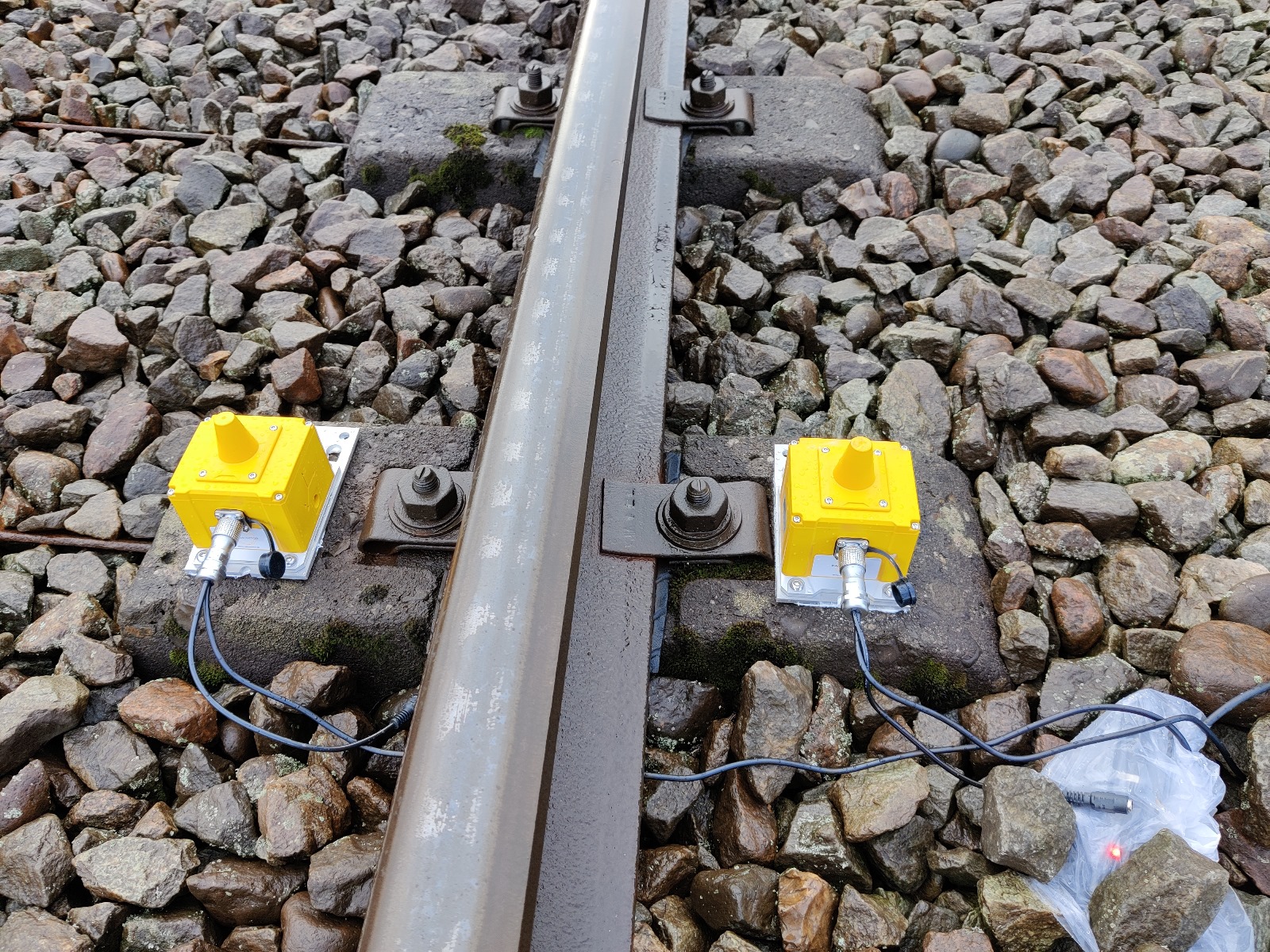
Figure 3. Close-up of BWSENSING wireless inclinometer deployment on site.
How the Solution Solves Customer Pain Points
1. High precision for subtle structural change detection
One of the biggest pain points in railway structure monitoring is the difficulty of capturing very small angular changes before they develop into more serious structural problems. With high resolution and high accuracy, the LWHD-WM400 helps customers distinguish meaningful structural variation more clearly, improving the reliability of early-stage monitoring data.
2. Lower deployment complexity through LoRa transmission
By using LoRa transmission under the LoRaWAN communication protocol, the solution reduces dependence on complex wired infrastructure. This improves installation efficiency and makes the monitoring system more suitable for distributed deployment across multiple track sections and project sites.
3. Better suitability for long-term outdoor applications
Railway monitoring systems must perform in harsh weather and changing field conditions. With industrial-grade temperature adaptability, IP68 protection and low-power operation, the LWHD-WM400 provides a more practical foundation for long-term real-world monitoring.
4. Improved operational efficiency for the customer
The product supports remote management, signal strength monitoring, battery query and temperature query, helping customers reduce manual intervention and improve the operational efficiency of distributed monitoring projects.
5. Stronger continuity and scalability
With automatic reconnection capability and support for multiple regional frequency bands, the solution is well suited for cross-country deployment and long-term monitoring strategies. This is particularly valuable for a company like Railmonitor ApS, which serves railway monitoring projects in multiple European markets.
From Standard Product Validation to Joint Innovation
A major strength of this partnership is that it evolved from product validation into collaborative innovation. The LWHD-WM400 first proved its value as a standard high-precision wireless inclinometer for railway monitoring. As the customer’s application needs became more specialized, both teams continued to optimize measurement performance based on field feedback and operational experience.
In 2024, this collaboration led to the development of the RM-1 model, designed to accurately measure the vertical Z-axis displacement of rails when trains pass. This development shows how BWSENSING not only provides mature sensing products, but also works closely with customers to extend technology into highly application-specific solutions.
The project therefore reflects more than a successful delivery case. It represents a long-term engineering partnership in which precision sensing technology was continuously refined to better match the real needs of railway structure monitoring.
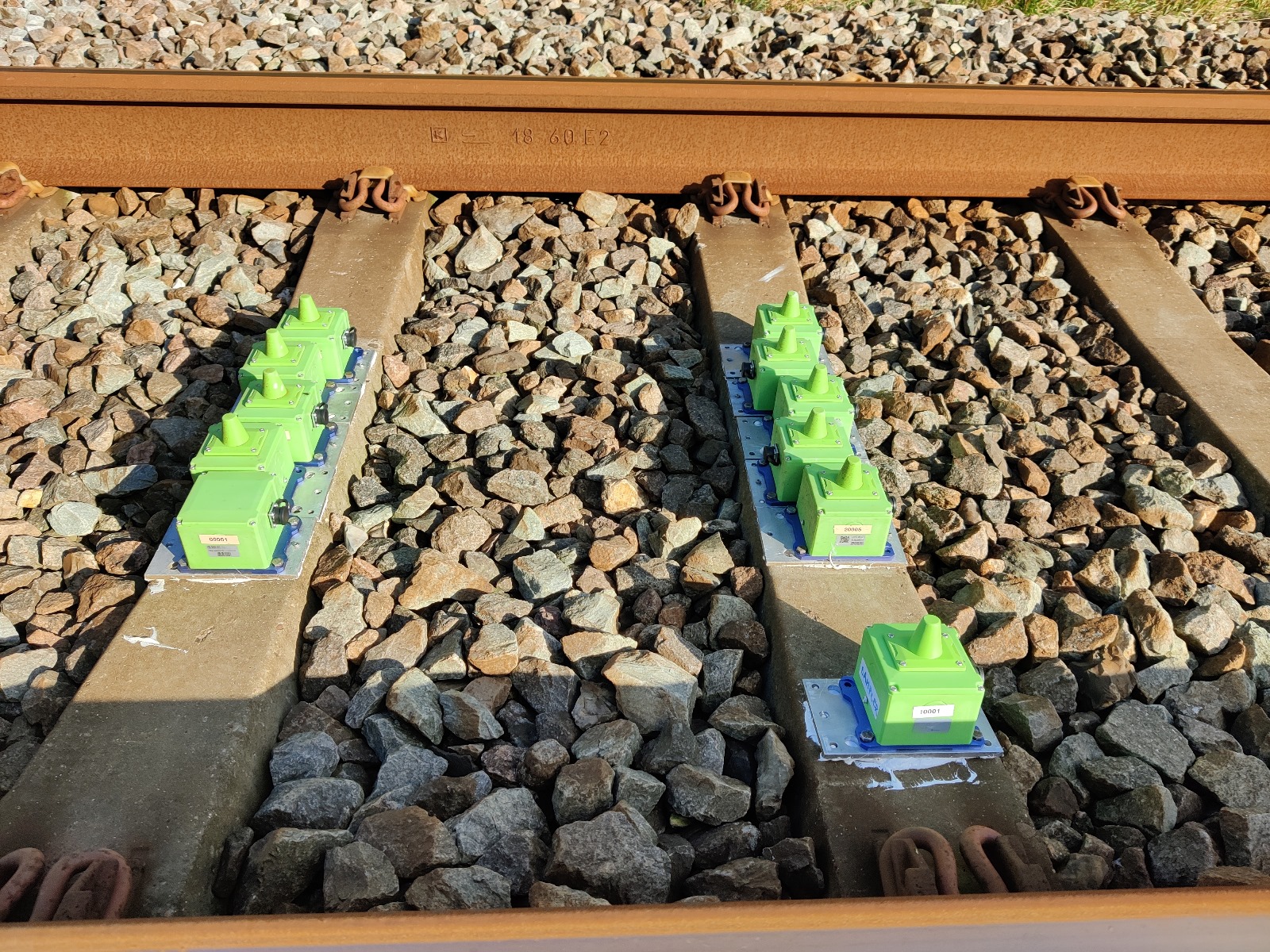
Figure 4. Multi-point deployment of the co-developed RM-1 solution.
Project Value
Through this multi-year cooperation, BWSENSING has helped Railmonitor ApS enhance its ability to deliver accurate, scalable and field-proven rail monitoring solutions. The project demonstrates how high-precision sensing can support safer and more efficient railway infrastructure monitoring across different regions and application scenarios.
For the customer, the value lies not only in obtaining monitoring data, but in obtaining data that is precise enough to support confident engineering judgment. By combining sensor accuracy, low-power LoRa transmission and continuous product optimization, BWSENSING helps transform structural monitoring into practical operational value.
At the same time, the case highlights BWSENSING’s strengths in inertial attitude sensing technology, customer-oriented development and international project support. It also demonstrates the company’s ability to move from standard product supply to collaborative innovation based on real application requirements.
Conclusion
The cooperation between BWSENSING and Railmonitor ApS is a strong example of how precision sensing technology can create real value in railway infrastructure monitoring. With the LWHD-WM400 as a proven foundation, and with further development toward the RM-1 model, BWSENSING has supported a monitoring solution that combines high precision, practical deployment and long-term scalability.
For railway applications where reliable data, structural insight and operational safety all matter, a high-performance wireless inclinometer with LoRa transmission and the LoRaWAN communication protocol can play a critical role in improving monitoring quality and enabling better maintenance decisions.
-
STAY CONNECTED




-
8:00am-7:00 pm Service Online
WhatsApp/Tel:+86 15050 672 146
+86 17606 118 008
Commercial:sales@bwsensing.com
Customer Service:support@bwsensing.com

Copyright © 2010-2026 Wuxi BEWIS Sensing Technology LLC 苏ICP备14001101号-6 Privacy Policy Cookies

 +86 189 2129 2620
+86 176 0611 8008 sales@bwsensing.com